

The Logical Fallacies of Humanoid Robotics Investment Theses – INGA314.com analysis
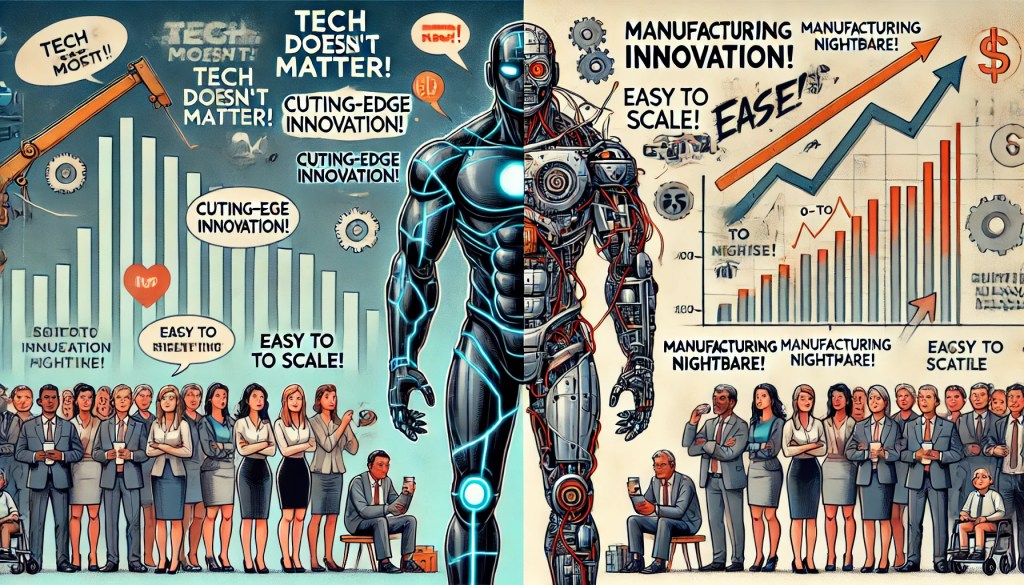
In the rapidly evolving landscape of emerging technologies, few sectors have captured investor imagination quite like humanoid robotics. Promises of human-like machines performing labor, leading to enormous economic potential, drive narratives proclaiming “0-to-Trillion” opportunities. Yet, these investment theses warrant closer logical scrutiny.
The Paradox of Technological Dismissal
One glaring contradiction prevalent in humanoid robotics investment narratives is the “technology dismissal paradox,” whereby narratives simultaneously assert “technology doesn’t matter” while evaluating and ranking robots predominantly by technological capabilities.
This contradiction exposes a misunderstanding of technology maturation. The claim, “you only need enough tech to perform 99% of the task,” ignores the exponential complexity and effort required for that final 1%, often crucial for real-world reliability and adaptability.
Boston Dynamics’ Atlas robot, renowned for impressive feats like backflips, illustrates this issue. These scripted performances, while captivating, fail to reflect the adaptability, efficiency, and reliability essential for genuine labor substitution.
The Manufacturing-Innovation False Dichotomy
Another logical inconsistency is the artificial separation of manufacturing scale from technological innovation. Companies like Tesla and Xiaomi are celebrated for manufacturing prowess, seemingly disregarding the continued necessity for technological breakthroughs.
Historically transformative innovations—Apple’s iPhone, personal computers, electric vehicles—demonstrate that groundbreaking technology breakthroughs precede and enable scale, not the reverse. Apple’s success hinged upon innovations in touch interfaces, battery management, and operating systems long before manufacturing efficiencies became relevant.
Today, humanoid robotics remains entrenched in the innovation stage. Current platforms fall short in reliability, energy efficiency, and economic viability. Meaningful manufacturing scale can only become relevant once these fundamental technological hurdles are overcome.
The Market Application Specificity Gap
A troubling analytical gap in robotics investment narratives is their generalized treatment of “humanoid robots” without adequately addressing drastically differing requirements across potential application domains:
- Healthcare: Must navigate stringent regulatory frameworks, rigorous safety standards, and precision demands.
- Manufacturing: Requires clear ROI justifications versus existing automation.
- Consumer Markets: Demand intuitive interfaces, consumer-friendly pricing, and clear value propositions.
- Logistics: Necessitate extreme reliability and seamless integration into existing infrastructure.
Each sector has distinct technological, regulatory, economic, and ethical challenges. Investment theses often oversimplify this complex landscape, undermining informed investment decisions.
The Valuation Timeline Inconsistency
Investment narratives frequently commit a temporal inconsistency, suggesting imminent investment opportunities in sectors realistically decades from significant deployment. The juxtaposition of near-term trillion-dollar market projections against modest mid-term estimates ($38 billion by 2035, Goldman Sachs) reveals unrealistic expectations.
Three timelines are often conflated:
- Technological readiness: When robots can reliably perform real-world tasks.
- Economic viability: When robots offer compelling cost advantages.
- Market penetration: When significant adoption occurs.
Misalignment across these timelines results in illogical expectations, creating undue investment risk.
Regulatory and Ethical Oversight
Most investment theses inadequately address regulatory and ethical considerations central to robotics adoption. Safety standards, employment implications, data privacy, and geopolitical risks significantly impact adoption timelines and profitability. Notably, companies with strong links to specific governments or controversial technologies often introduce overlooked risks into investment frameworks.
Investor Psychology and Hype Cycles
Humanoid robotics investment theses frequently exploit investor psychology, particularly fear of missing out (FOMO) and hype-driven expectations. This dynamic can inflate valuations beyond fundamental realities, leading to eventual market corrections as technological realities fail to match speculative exuberance.
Towards More Coherent Investment Frameworks
For investors genuinely interested in humanoid robotics, adopting logically consistent frameworks is crucial:
- Segment-specific analysis: Clearly recognizing unique trajectories in healthcare, industrial, consumer, and logistics applications.
- Capability-based evaluation: Identifying technological barriers and companies positioned to overcome them.
- Full value-chain perspective: Considering component technologies (actuators, sensors, batteries) that may capture disproportionate value.
- Milestone-based valuation: Linking investment timing to specific technological and commercial milestones rather than speculative endpoints.
Ultimately, success in humanoid robotics will not hinge solely on manufacturing scale or isolated technological innovation but on strategically integrating both aspects to deliver real-world value within specific application domains. Investors must approach this sector with disciplined realism, aware of the complexities involved, moving beyond logically inconsistent narratives towards robust, grounded analytical frameworks.
 System D