

Does running a marathon temporarily change your brain structure? INGA314.com analysis The evidence requires careful examination.
https://www.nature.com/articles/s42255-025-01244-7
The Surprising Discovery
Picture this: You’ve just completed a marathon—26.2 grueling miles pushing your body to its limits. Your muscles ache, your joints are stiff, and you’re utterly exhausted. But what if I told you that deep inside your brain, something unexpected was happening?
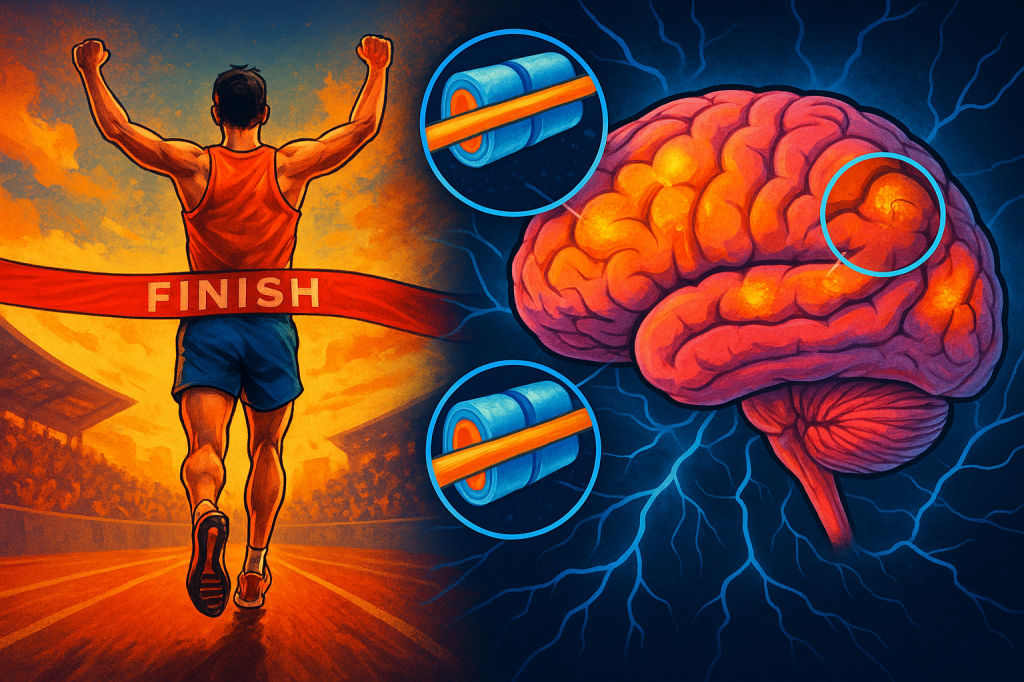
According to a recent study published in Nature Metabolism, marathon running may temporarily reduce the myelin content in specific areas of your brain.
Myelin is the fatty insulating material that wraps around nerve fibers, allowing electrical signals to transmit quickly and efficiently. It’s essential for proper brain function, making up the “white matter” of your brain. The study, led by researchers Pedro Ramos-Cabrer and Carlos Matute, suggests that this myelin reduction isn’t permanent—it appears to fully recover within two months.
What Did the Researchers Find?
The research team used a specialized MRI technique called multicomponent relaxometry to measure something called the “myelin water fraction” (MWF)—essentially a way to estimate myelin content in the brain. They scanned 10 marathon runners before and after completing a marathon, with some participants also getting scanned two weeks and two months later.
Their findings were striking: After completing a marathon, runners showed reductions in MWF in specific brain regions involved in:
- Motor coordination (the pathways controlling movement)
- Sensory processing
- Emotional integration
The biggest changes appeared in areas called the pontine crossing tract and corticospinal tract, with decreases of 28% and 26% respectively. Two months later, MWF levels returned to normal in all affected areas.
A Bold Hypothesis: Is Your Brain Eating Itself For Energy?
The researchers propose a fascinating explanation: During extreme endurance exercise, when your body is desperately seeking energy, your brain might be using myelin lipids (fats) as an emergency energy source.
This would represent a previously unknown form of “metabolic myelin plasticity”—essentially, your brain adapts by temporarily sacrificing some insulation around nerve fibers to keep functioning during extreme exertion.
It’s an intriguing idea that builds on recent animal research suggesting that myelin-producing cells can use fatty acids for energy when glucose (the brain’s preferred fuel) is in short supply. The marathon, with its extreme energy demands, might be creating just such a scenario.
Looking Behind the Headlines: What Should We Make of This Study?
While the findings are fascinating, there are several reasons to interpret this study with caution:
Small Sample Size and Incomplete Follow-up
The study included only 10 participants initially, with just 2 participants at the two-week follow-up and 6 at the two-month mark. This small, declining sample makes it difficult to draw strong conclusions about recovery patterns.
The Measurement Challenge
MWF is an indirect measure of myelin content—it measures water trapped between myelin layers, not myelin itself. The authors acknowledge this limitation, noting that MWF changes are typically larger than actual myelin changes. This means the true myelin reduction might be 40-50% less than what was measured.
Alternative Explanations
While the researchers propose myelin being used as an energy source, other explanations weren’t fully ruled out:
- Changes in myelin membrane permeability
- Alterations in brain iron concentration
- Temporary axonal swelling
Missing Metabolic Evidence
The study didn’t directly measure any metabolic processes that would confirm myelin was actually being broken down for energy. This leaves a significant gap between the observation (MWF reduction) and the proposed explanation (myelin as energy source).
What Does This Mean for Runners?
Before you cancel your marathon registration, it’s important to note that these changes appear to be temporary and may represent a normal adaptive response to extreme exercise. The researchers found no evidence of harmful effects, and MWF levels returned to normal after two months.
If anything, this study highlights the remarkable adaptability of the human brain. Just as your muscles and cardiovascular system adapt to training, your brain may have its own ways of handling extreme challenges.
Broader Implications: Beyond the Marathon
The researchers speculate that this finding might have implications for understanding conditions where energy metabolism is compromised, such as:
- Multiple sclerosis (a demyelinating disease)
- Anorexia nervosa (where nutritional deficits affect brain structure)
- Amyotrophic lateral sclerosis (ALS)
However, these connections remain speculative at this point. More research with larger sample sizes and direct metabolic measurements would be needed to confirm the initial findings and explore these potential links.
The Takeaway: Fascinating Science in Progress
This study offers a glimpse into the potentially surprising ways our brains respond to extreme physical challenges. It suggests that the relationship between physical exertion and brain structure is more dynamic than previously thought.
Like much of cutting-edge science, these findings raise as many questions as they answer:
- Why does myelin reduction happen in some brain regions but not others?
- What triggers the recovery process?
- Does this phenomenon occur in other forms of extreme exertion?
- Could this process have long-term implications for frequent marathon runners?
As researchers continue to investigate these questions, one thing is clear: The human body—and brain—are remarkably adaptive systems capable of surprising responses to extreme challenges. The marathon isn’t just a test of your legs and lungs—it might be taking your brain on quite a journey too.
Would you like to learn more about how exercise affects your brain? Let me know in the comments below!
Disclaimer: This article discusses preliminary research findings and should not be taken as medical advice. Always consult with healthcare professionals about your exercise regimen, especially for endurance events.
 System D