

https://www.nationthailand.com/news/general/40047995
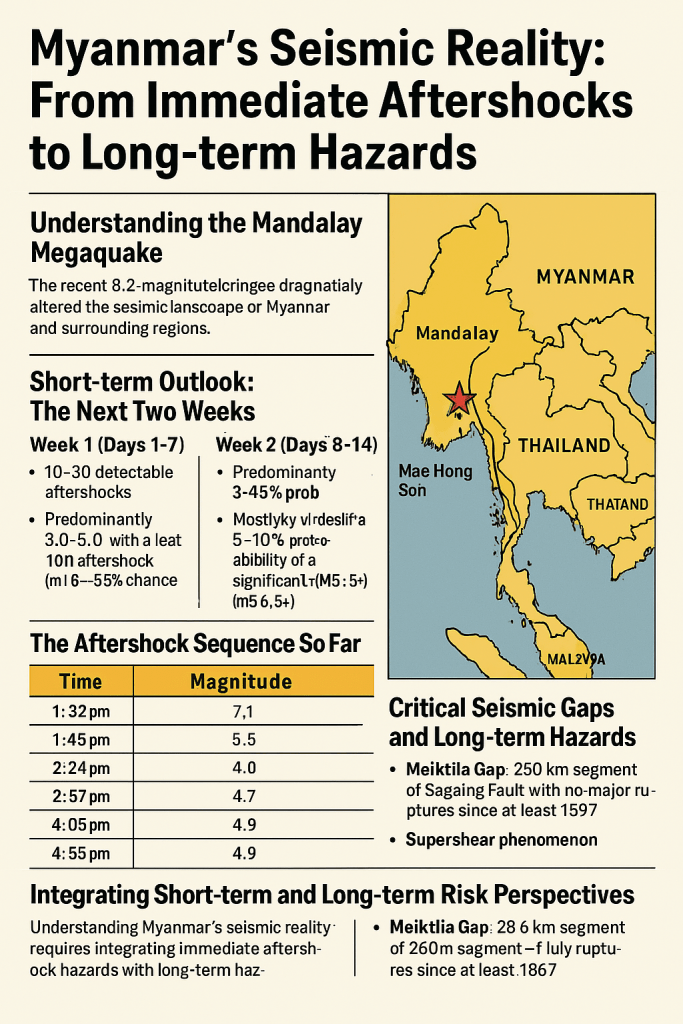
Understanding the Mandalay Megaquake. INGA314.com analysis
The recent 8.2-magnitude earthquake near Mandalay has dramatically altered the seismic landscape of Myanmar and surrounding regions. Occurring at 1:20pm local time at a shallow depth of 10 kilometers, this powerful event has triggered a complex aftershock sequence that requires careful analysis. Located approximately 392 kilometers from Thailand’s Mae Hong Son province, the earthquake’s effects have rippled throughout Southeast Asia.
The Aftershock Sequence So Far
The Thai Meteorological Department’s Earthquake Observation Division has meticulously tracked the aftershock sequence, recording 12 significant aftershocks in the hours immediately following the main event:
TimeMagnitude1:32pm7.11:45pm5.52:24pm4.02:37pm5.22:42pm3.92:57pm4.73:21pm4.03:45pm3.73:52pm3.84:26pm4.34:30pm4.54:55pm4.9
While officials have stated that aftershocks would gradually decrease in intensity, the actual pattern has been more complex. The sequence shows the expected initial decline from the powerful 7.1 aftershock, but includes several instances where magnitudes temporarily increased, including a concerning uptick in the final three recorded aftershocks.
Short-term Outlook: The Next Two Weeks
Week 1 (Days 1-7)
- Frequency: Expect 10-30 detectable aftershocks daily, with a gradual decline
- Magnitude Range: Predominantly 3.0-5.0, with a 40-60% chance of at least one aftershock between 5.0-6.0
- Geographic Distribution: Concentrated within 100km of the epicenter along the Sagaing Fault
- Critical Risk Period: 15-25% probability of a significant aftershock (M6.0+), most likely within the first 3-4 days
Week 2 (Days 8-14)
- Frequency: Declining to 5-15 detectable aftershocks daily
- Magnitude Range: Mostly 2.5-4.5, with a 20-30% probability of a 5.0-5.5 event
- Geographic Distribution: Continuing along the Sagaing Fault, possibly extending to adjacent segments
- Critical Risk Period: Reduced 5-10% probability of a significant aftershock (M5.5+)
Regional Impact Forecast
Myanmar:
- Mandalay Region: Felt aftershocks (M3.5+) almost daily during week 1, decreasing to every 2-3 days in week 2
- Naypyidaw Area: Occasional felt aftershocks during week 1, becoming rare in week 2
- Infrastructure Concerns: Cumulative strain on damaged structures; secondary hazards like landslides remain possible
Thailand:
- Northern Provinces: Possible light shaking from larger aftershocks during week 1, unlikely to be felt during week 2
- Central and Southern Thailand: No significant effects expected
Other Neighboring Countries:
- Laos and Bangladesh: Similar pattern to Northern Thailand with diminishing probability of felt events
- Northeast India: Possible light shaking from larger aftershocks, primarily during week 1
Outlier Scenarios to Monitor
While the above represents the most likely scenario, two important outlier possibilities warrant attention:
- Low Probability, High Impact Scenario (5-8% chance)
- Triggering of a large aftershock (M7.0+) on an adjacent fault segment
- This would effectively restart the aftershock sequence and require revised forecasts
- Most critical time window: days 2-5 after the mainshock
- Low Probability, Low Impact Scenario (15-20% chance)
- Faster than expected decay of aftershock sequence
- Would result in fewer than predicted aftershocks, particularly in the M4.0+ range
- Would suggest less residual strain in the fault system than typical
The Broader Context: Understanding the Sagaing Fault System
The recent earthquake must be understood within the broader context of Myanmar’s Sagaing Fault, one of Southeast Asia’s most significant tectonic features. This right-lateral strike-slip fault system, similar to California’s San Andreas Fault, accommodates the relative motion between the Indian and Sunda tectonic plates.
Critical Seismic Gaps and Long-term Hazards
Geological research has identified several concerning segments along the Sagaing Fault:
The Meiktila Gap (19.2°N–21.5°N)
- 260 km segment with no major ruptures since at least 1897
- Potential for a Mw 7.9 earthquake if fully ruptured
- Represents a significant long-term seismic hazard
Andaman Sea Segment (South of Yangon)
- 180 km gap that could produce a Mw 7.7 event
- Currently assessed as lower hazard (<10% chance of Mw 7.0 in 50 years)
- Still warrants monitoring due to potential coastal impact
Myitkyina–Mandalay Segment
- Highest hazard segment (50% probability of a Mw 6.4–7.2 quake within 50 years)
- Current aftershocks may be related to this segment
- Requires careful monitoring for signs of additional strain release
The Supershear Phenomenon
A concerning characteristic of the Sagaing Fault is its potential for “supershear” earthquakes—where ruptures propagate faster than seismic waves. This phenomenon, enabled by the fault’s unusually straight geometry, can:
- Amplify ground shaking intensity
- Extend damage areas
- Produce more severe high-frequency seismic waves
Scientists are currently analyzing whether the recent 8.2 earthquake exhibited supershear characteristics, which could inform future risk assessments and building code requirements.
Reconciling Apparent Contradictions in Earthquake Information
Our analysis has identified several seeming paradoxes in the earthquake information:
The Aftershock Pattern Paradox
While officials stated that aftershocks would “gradually decrease in intensity,” the actual sequence showed several magnitude increases, including the final three recorded aftershocks. This reflects the reality that aftershock sequences rarely follow perfectly smooth declining patterns, instead exhibiting fluctuations around a generally decreasing trend.
The Prediction Paradox
Officials acknowledge “it is not possible to accurately predict when an earthquake will occur,” yet provide specific probability estimates like “50% probability of a Mw 6.4–7.2 quake within 50 years.” This apparent contradiction stems from different types of forecasting: precise timing (impossible) versus probability ranges based on fault characteristics and historical patterns (scientifically valid).
The Thailand Impact Paradox
Authorities stated there “should not be any significant tremors felt in Thailand for now,” while also warning of “continued tremors for weeks.” This is resolved by understanding the distinction between “significant” (damage-causing) tremors versus technically detectable but minor aftershocks.
The Magnitude Discrepancy
The recent earthquake registered at 8.2, yet the identified high-risk segments were previously estimated to generate maximum earthquakes of 7.9 and 7.7. This suggests either:
- The earthquake occurred on a previously underestimated segment
- The Sagaing Fault is capable of larger events than previously thought
- The preliminary magnitude may be revised upon further analysis
Integrating Short-term and Long-term Risk Perspectives
Understanding Myanmar’s seismic reality requires integrating both immediate aftershock hazards and long-term fault system dynamics:
Short-term Considerations (Next 2 Weeks)
- Aftershock sequence management
- Emergency response coordination
- Damaged infrastructure assessment
- Temporary shelter requirements
- Public communication strategies
Medium-term Considerations (Next 6 Months)
- Continued seismic monitoring along the entire fault
- Infrastructure repair priorities
- Strain redistribution analysis
- Updated regional risk assessments
Long-term Considerations (Years to Decades)
- Addressing identified seismic gaps (particularly the Meiktila Gap)
- Building code implementation and enforcement
- Infrastructure resilience planning
- Cross-border coordination mechanisms
- Public education and preparedness programs
Risk Amplification Factors
Several non-geological factors significantly amplify the seismic risk in the region:
- Structural Vulnerability: Many buildings in Myanmar lack earthquake-resistant design
- Urban Concentration: High population density near major fault zones
- Limited Warning Systems: Insufficient early warning infrastructure
- Response Capacity Gaps: Limited emergency response resources
- Cross-border Coordination Challenges: Complex regional relationships affecting information sharing
Practical Guidance for Different Stakeholders
For Residents in Affected Areas
- Maintain earthquake preparedness supplies for at least two weeks
- Be particularly vigilant during week 1 when a significant aftershock remains possible
- Identify and avoid vulnerable structures and landslide-prone areas
- Follow official guidance from local authorities
For Emergency Management Agencies
- Focus monitoring on temporal and spatial migration patterns of aftershocks
- Watch for increasing event rates in areas away from the original epicenter
- Pay special attention to the Meiktila Gap region for any unusual activity
- Prepare for potential triggered events on adjacent fault segments
For Regional Governments
- Enhance cross-border seismic data sharing mechanisms
- Coordinate emergency response resources across boundaries
- Standardize public communication protocols to avoid contradictory messaging
- Integrate short-term aftershock management with long-term resilience building
Conclusion: Embracing Uncertainty While Building Resilience
The recent 8.2-magnitude earthquake near Mandalay has highlighted both the power of these seismic events and the challenges in predicting their exact behavior. While we can forecast general aftershock patterns and probabilities, the complex nature of fault systems means uncertainty will always remain.
The most effective approach combines:
- Rigorous scientific monitoring
- Transparent risk communication
- Practical preparedness measures
- Long-term infrastructure resilience building
By integrating perspectives across different time horizons—from immediate aftershock sequences to decades-long fault behavior—we can develop more effective strategies for living with seismic risk in one of Earth’s most tectonically active regions.
This analysis integrates short-term aftershock forecasts with long-term seismic hazard assessments to provide a comprehensive view of Myanmar’s earthquake situation. All probability estimates are based on current scientific understanding and may be revised as new data becomes available.
 System D