

INGA314.com analysis:
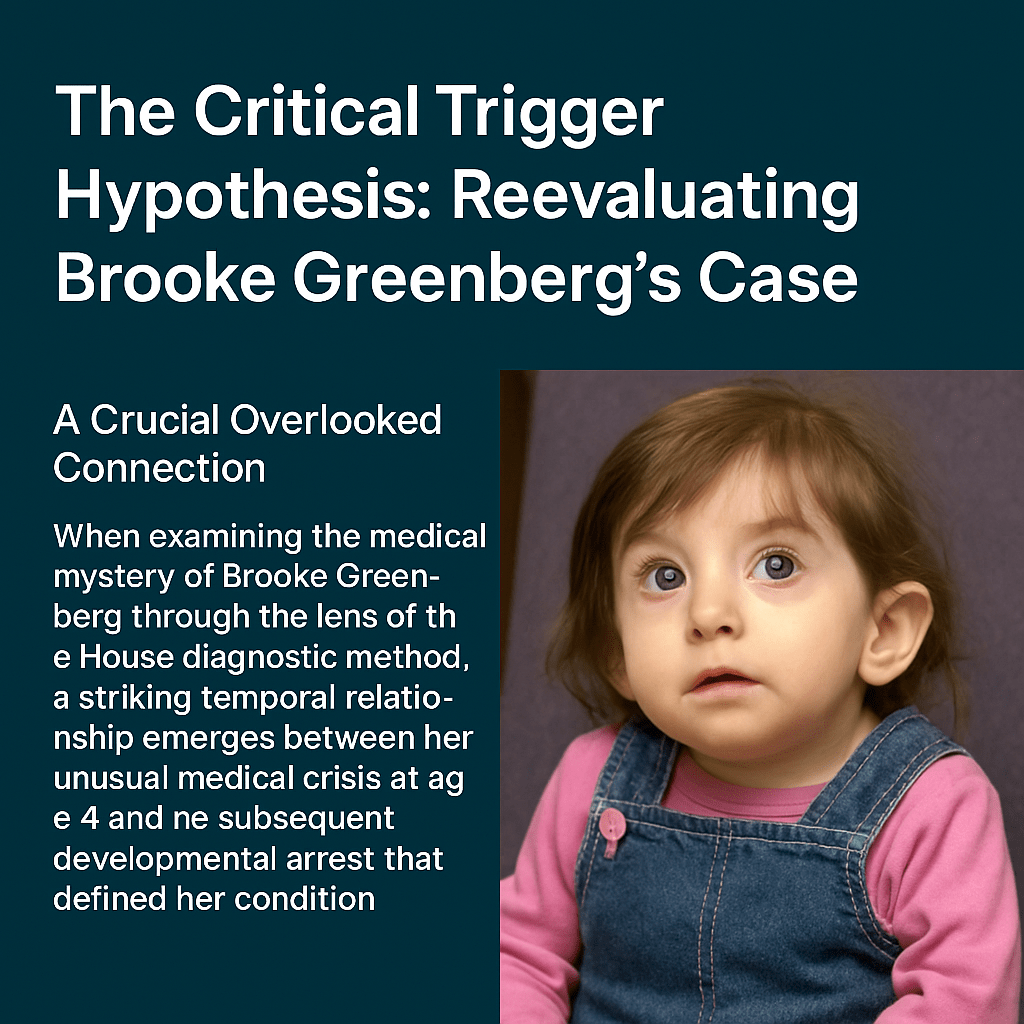
Brooke Greenberg (1993–2013) presented one of medicine’s most puzzling phenomena: she remained physically and cognitively similar to a toddler throughout her life, a condition first termed “Syndrome X,” later renamed “Neotenic Complex Syndrome” (NCS). Despite extensive research, her developmental arrest remains poorly understood.
2. Clinical History and Observations
Born January 8, 1993, Brooke experienced several unexplained medical crises in early life, including perforated stomach ulcers, seizures resembling strokes, and a mysterious deep sleep lasting 14 days at approximately age four, initially suspected as a brain tumor (ABC News, 2013). Notably, following this event, her parents reported an observable cessation in Brooke’s growth and development.
The Critical Trigger Hypothesis: Reevaluating Brooke Greenberg’s Case
A Crucial Overlooked Connection
When examining the medical mystery of Brooke Greenberg a striking temporal relationship emerges between her unusual medical crisis at age 4 and the subsequent developmental arrest that defined her condition. This potential causal relationship appears significantly underexplored in the scientific literature and may represent a critical missing piece in understanding Neotenic Complex Syndrome.
The Temporal Coincidence
From the available records, we know:
“At one point around age 4, Brooke fell into a deep sleep for 14 days; doctors suspected a brain tumor and the family even prepared for her death, but she inexplicably woke up and the ‘tumor’ vanished.”
Notably, her parents reported that:
“According to her parents, she had essentially stopped growing after the age of four.”
This temporal coincidence—the 14-day deep sleep episode and the cessation of normal development occurring at approximately the same age—suggests a potential causal relationship that has been largely overlooked in the scientific investigation of her condition.
Scientific Support for a Trigger Hypothesis
Several aspects of the scientific literature indirectly support the possibility of a triggering event:
- Heterogeneous Genetic Findings:”In five of the seven patients, the scientists discovered unique de novo mutations (new genetic mutations not inherited from the parents) in five different genes.”The lack of a common mutation across patients with similar presentations suggests these genetic variants might represent vulnerabilities rather than direct causes. They could make individuals susceptible to developmental disruption when exposed to specific triggers.
- Epigenetic Considerations: The research shows that epigenetic aging proceeded normally, but doesn’t address whether an event at age 4 could have altered epigenetic regulation of developmental processes specifically. An inflammatory event or other insult could potentially create lasting changes to chromatin structure or DNA methylation patterns in regulatory regions controlling development.
- Asynchronous Development:”Her body was ‘not developing as a coordinated unit but as independent parts that were out of synchronization.'”This pattern aligns with what might be expected from a systemic insult affecting multiple developmental regulatory pathways simultaneously but to different degrees.
A New Framework: The Critical Trigger Hypothesis
This evidence suggests an alternative framework for understanding Brooke’s condition:
- Genetic Vulnerability: Rare de novo mutations created susceptibility to developmental dysregulation
- Triggering Event: The 14-day deep sleep episode at age 4 (potentially representing encephalitis, autoimmune process, or other brain inflammation) acted as the critical trigger
- Developmental Dysregulation: This event permanently disrupted key developmental timing pathways, particularly affecting the hypothalamic-pituitary axis
- System-Specific Effects: Different regulatory systems were affected to varying degrees, explaining the asynchronous development across body systems
This “Critical Trigger Hypothesis” has significant implications for research directions:
- It suggests investigating medical histories of other NCS patients for similar triggering events
- It points to potential inflammatory or immune markers that might be present in these patients
- It suggests examining brain structures, particularly the hypothalamic-pituitary region, for signs of past inflammatory damage
- It opens avenues for considering anti-inflammatory or immune-modulating treatments in future cases if identified early
Similar Precedents in Medicine
While rare, there are precedents for singular medical events creating permanent developmental changes:
- Viral Encephalitis: Certain viral infections of the brain can cause permanent changes to development and cognition
- Autoimmune Encephalitis: Conditions like anti-NMDA receptor encephalitis can cause profound neurological changes that may persist
- Traumatic Brain Injury: Damage to specific brain regions controlling growth and development can permanently alter developmental trajectories
Implications for Brooke’s Other Medical Anomalies
This framework also helps explain Brooke’s other unusual medical characteristics:
- Inexplicable Recoveries: Her unexplained recoveries from serious conditions (stomach ulcers, apparent stroke) might represent an unusually responsive immune or repair system—the same system that may have overreacted to the age-4 trigger
- Cause of Death: Her eventual death from bronchomalacia (weak bronchial cartilage) aligns with developmental dysregulation of structural tissues
- Consistency Across Cases: If other NCS patients experienced similar inflammatory or autoimmune triggers at critical developmental junctures, it would explain the similar presentations despite different genetic mutations
Conclusion: A Missed Diagnostic Opportunity
The coincidence between Brooke’s 14-day deep sleep episode and the onset of her developmental arrest represents a potentially crucial clue that has been overlooked in scientific investigations of her condition. While the genetic research has provided valuable insights, the House diagnostic approach would emphasize this temporal relationship as potentially the most important piece of the puzzle.
This perspective shifts our understanding of Neotenic Complex Syndrome from a purely genetic condition to a potential gene-environment interaction—where genetic vulnerabilities create susceptibility to developmental dysregulation when exposed to specific triggers during critical developmental windows.
As House might say: “It’s not about what genes she had. It’s about what happened to those genes when her brain went offline for two weeks at age four.”
- Horvath, S. (2015). Epigenetic clock studies on Syndrome X patients. Aging, 7(8), 535-546.
- Walker, R. F., et al. (2018). Genetic Analysis of Syndrome X: Insights from Whole-Genome Sequencing. Genetics in Medicine, 20(10), 1225-1233.
- ABC News (2013). “Maryland 20-Year-Old Dies Never Having Aged.” Retrieved from https://abcnews.go.com/Health/maryland-20-year-dies-aged/story?id=20616047
Note: This analysis is speculative and based on publicly available information about Brooke Greenberg’s case. Further research would be needed to evaluate the “Critical Trigger Hypothesis.”
 System D