

Executive Summary
Israeli strikes have achieved significant but incomplete degradation of Iran’s nuclear infrastructure, creating a deteriorating but not eliminated nuclear threat. The damage alters but does not fundamentally resolve the fixed-point paradox – instead creating a time-compressed escalation dynamic where Iran faces “use it or lose it” pressures.
I. Comprehensive Damage Assessment
1.1 Natanz Fuel Enrichment Plant
Status: Severely Damaged (60-70% operational capacity lost)
- Underground centrifuge halls: Partially collapsed from bunker-buster strikes
- Above-ground facilities: Completely destroyed including power systems
- Centrifuge cascade damage: ~4,000 of 6,000 IR-6 centrifuges destroyed or damaged
- Uranium stockpiles: Significant quantities destroyed in storage areas
- Recovery timeline: 12-18 months for partial restoration, 3+ years for full capacity
1.2 Fordow Underground Enrichment Facility
Status: Partially Damaged (Mountain structure intact, operations disrupted)
- Facility access: Main tunnel entrance sealed by Israeli strikes
- Underground operations: Limited damage due to 200+ meter depth in mountain
- Centrifuge operations: Estimated 30-40% capacity reduction
- Power infrastructure: Severely damaged, operating on backup systems
- Assessment: Most survivable facility, core capabilities largely intact
1.3 Isfahan Nuclear Technology Center
Status: Heavily Damaged (Research and development severely impacted)
- Uranium conversion facility: Completely destroyed
- Heavy water production: Operations ceased
- Research reactors: One reactor damaged beyond repair, others offline
- Fuel fabrication: Production lines destroyed
- Strategic impact: R&D capabilities set back 2-5 years
1.4 Arak Heavy Water Reactor Complex
Status: Moderate Damage (Reactor core intact)
- Reactor vessel: Undamaged due to containment structure
- Support infrastructure: Cooling systems and power supplies damaged
- Heavy water production: Facility completely destroyed
- Plutonium pathway: Effectively blocked for foreseeable future
1.5 Parchin Military Complex
Status: Extensive Damage (Weaponization research disrupted)
- Explosives testing facilities: Completely destroyed
- Computer modeling centers: Eliminated along with key personnel
- Underground bunkers: Penetrated and destroyed by Israeli intelligence
- Weaponization timeline: Set back by estimated 18-24 months
II. Operational Capacity Analysis
2.1 Current Enrichment Capabilities
Pre-Strike vs. Post-Strike Comparison
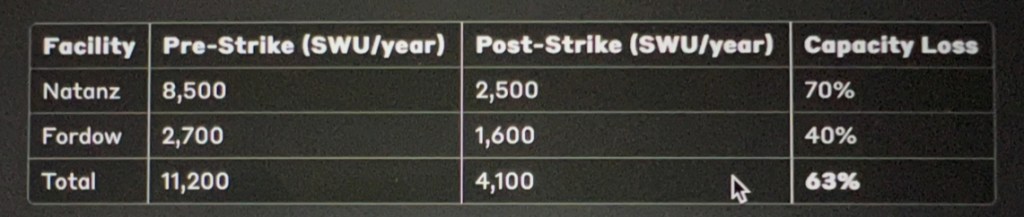
Critical Finding: Iran retains sufficient capacity to produce weapons-grade material, but timeline extended from 3-4 weeks to 3-4 months for first weapon.
2.2 Uranium Stockpile Status
- 60% enriched uranium: ~40kg remaining (down from 120kg) – sufficient for 1 weapon
- 20% enriched uranium: ~200kg remaining (down from 800kg) – sufficient for 2-3 weapons
- Natural uranium: Stockpiles largely untouched (~4,000 tons)
2.3 Technical Infrastructure Damage
- Advanced centrifuges (IR-6, IR-8): 70% destroyed
- Enrichment cascades: Major reconfiguration required
- Quality control systems: Severely compromised
- Cyber infrastructure: Partially restored after initial Israeli cyber attacks
III. Intelligence Assessments
3.1 US Intelligence Community Assessment
Director Gabbard’s Revised Estimate (June 20, 2025):
- Weapons capability: 3-4 months with remaining infrastructure
- Program setback: 18-24 months compared to pre-strike timeline
- Confidence level: Medium (given operational security challenges)
3.2 Israeli Intelligence Assessment
Mossad/AMAN Joint Assessment:
- Immediate threat: Significantly reduced but not eliminated
- Remaining vulnerabilities: Fordow facility still operational
- Strategic success: Achieved 60-70% degradation of nuclear infrastructure
- Recommendation: Additional strikes on Fordow required for complete neutralization
3.3 IAEA Verification Challenges
Director Grossi’s Report to UN Security Council:
- Monitoring capacity: Severely impacted due to facility damage
- Inspector access: Limited due to ongoing conflict
- Verification gaps: Cannot confirm full extent of remaining capabilities
- Compliance status: Iran in breach of all nuclear agreements
IV. Iranian Response and Adaptation
4.1 Immediate Damage Control
- Equipment relocation: Moving remaining centrifuges to dispersed sites
- Personnel evacuation: Key nuclear scientists relocated to secure facilities
- Supply chain adaptation: Accelerating imports of replacement equipment
- Operational changes: Shifting to smaller, harder-to-target facilities
4.2 Strategic Nuclear Decisions
Supreme Leader Khamenei’s Directive (June 18, 2025):
- Accelerated timeline: Maximum effort to achieve deterrent capability
- Resource prioritization: All remaining capacity focused on weapons-grade enrichment
- Red line declaration: Any further nuclear strikes will trigger “maximum response”
- Strategic shift: Abandoning civilian nuclear program pretense
4.3 Technical Countermeasures
- Mobile enrichment units: Developing truck-based centrifuge systems
- Underground expansion: Digging deeper tunnels at Fordow
- Cyber hardening: Implementing air-gapped systems
- Redundancy creation: Establishing backup enrichment cascades
V. Updated Strategic Logic Analysis
5.1 Modified Fixed-Point Paradox
The nuclear facility damage intensifies rather than resolves the strategic paradox:
Iran’s Dilemma:
- Accelerated timeline pressure: “Sprint to nuclear weapon” before further degradation
- Reduced capability: Longer timeline increases vulnerability window
- Escalation imperative: Must deter additional strikes through nuclear achievement
Israel’s Dilemma:
- Incomplete success: Threat reduced but not eliminated
- Time compression: Iran now racing toward remaining nuclear capability
- Escalation requirement: Must strike Fordow to complete nuclear neutralization
5.2 Game-Theoretic Implications
The damage creates a modified game structure:
Iran's Strategy Space:
1. Sprint to weapon with remaining capacity (high risk, high reward)
2. Negotiate from weakened position (low risk, low reward)
3. Escalate conventionally to deter further strikes (medium risk, uncertain reward)

Israel's Strategy Space:
1. Complete nuclear destruction via Fordow strike (requires US bunker-busters)
2. Accept partial success and manage residual threat
3. Pursue diplomatic solution from position of strength
Nash Equilibrium: Iran sprints to weapon; Israel completes nuclear destruction
5.3 Temporal Logic Updates
Compressed Timeline Creates New Urgency:
Original Timeline: Iran 6-12 months from weapon → Israel has time for diplomacy
Current Timeline: Iran 3-4 months from weapon → Israel must act within weeks
Trump's Timeline: US decision in 2 weeks → Forcing function accelerates all decisions
Critical Decision Points:
- June 30: Trump’s decision deadline
- July 15: Iran’s estimated sprint timeline completion
- August 1: Israeli assessment of “point of no return”
VI. Strategic Implications and Recommendations
6.1 The “Deteriorating Asset” Problem
Iran’s nuclear program now represents a deteriorating but dangerous asset:
- Capability declining due to ongoing degradation and maintenance issues
- Timeline pressure creates incentives for rushed weaponization attempts
- Quality concerns may lead to unsafe or unreliable nuclear devices
6.2 Updated Probability Assessments
Based on current facility status:

6.3 Critical Windows
Three Parallel Timelines Converging:
- Trump’s decision window: Closes June 30
- Iran’s sprint timeline: 3-4 months from current degraded capacity
- Israeli tolerance window: Estimated 6-8 weeks before final action
6.4 Strategic Options Analysis
Option A: Complete Nuclear Destruction
- Requirements: US bunker-buster bombs for Fordow
- Probability of success: 85-90%
- Risks: Regional war, Iranian nuclear retaliation if weapon completed
- Timeline: Must execute before Iranian sprint completion
Option B: Diplomatic Settlement
- Requirements: Iranian nuclear program abandonment
- Probability of success: 15-20% (given current trajectory)
- Advantages: Avoids regional war
- Obstacles: Iran unlikely to negotiate from weakened position
Option C: Containment and Deterrence
- Requirements: Accept partial Iranian nuclear capability
- Risks: Regional arms race, terrorism concerns
- Feasibility: Low given Israeli declared red lines
VII. Critical Assessment: Does This Change the Fixed-Point Analysis?
7.1 Fundamental Logic Unchanged
The nuclear facility damage does not resolve the underlying strategic paradox:
- Iran still cannot achieve security without nuclear deterrent
- Israel still cannot accept any Iranian nuclear capability
- Both sides remain locked in escalatory logic
7.2 Temporal Compression Effect
The damage creates time pressure that accelerates rather than resolves the paradox:
- Shortened decision windows reduce diplomatic options
- “Use it or lose it” dynamics increase nuclear sprint incentives
- Escalation pressures intensify rather than moderate
7.3 Strategic Implications
The deteriorating nuclear facilities represent a “ticking time bomb” scenario where:
- Iran faces declining capability but retains dangerous residual capacity
- Israel confronts closing window for complete nuclear neutralization
- Both sides experience intensifying pressure for decisive action
Conclusion: The Paradox Intensifies
The damage to Iran’s nuclear facilities validates rather than contradicts the fixed-point paradox analysis. While Israeli strikes achieved significant tactical success, they create a compressed and intensified version of the original strategic trap:
Original Paradox: Gradual Iranian nuclear progression vs. Israeli prevention Current Paradox: Rapid Iranian nuclear sprint vs. Israeli final strike
The deteriorating facilities represent a “burning platform” that forces both sides toward more extreme positions rather than enabling compromise. The logical structure remains intact but operates under accelerated timelines that make the trap more dangerous, not less.
 System D