

A 15-amino acid sequence shows remarkable regenerative properties in animals—but regulatory barriers prevent human trials
The Science Behind the Hype
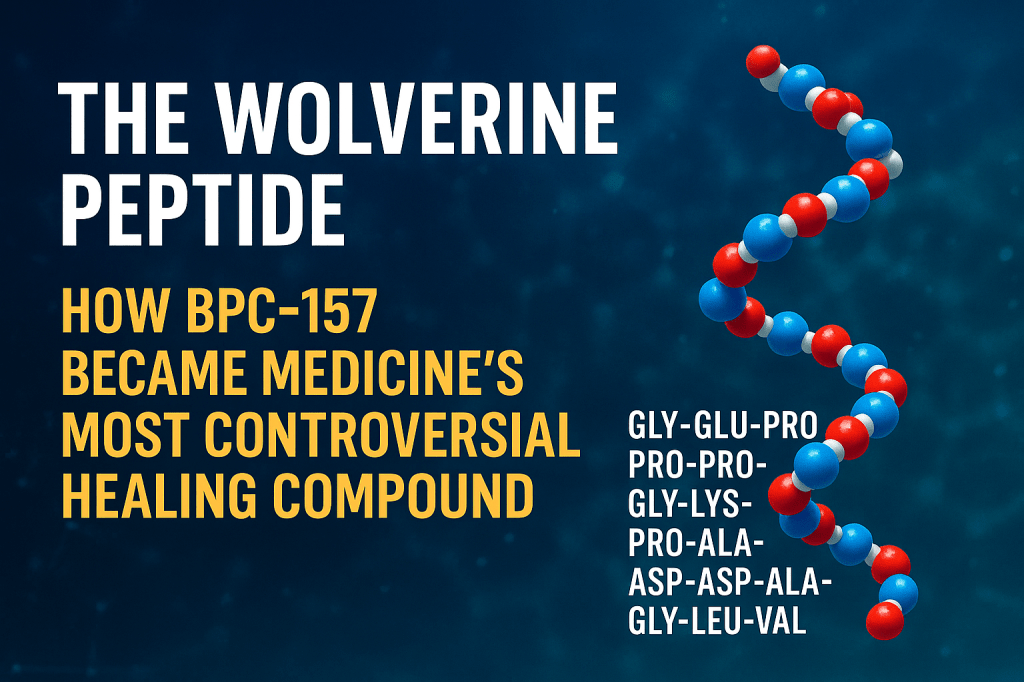
BPC-157 (Gly-Glu-Pro-Pro-Pro-Gly-Lys-Pro-Ala-Asp-Asp-Ala-Gly-Leu-Val) is a synthetic pentadecapeptide derived from body protection compound (BPC), a protein isolated from human gastric juice. Since its first characterization in the 1990s, this 15-amino acid sequence has generated over 100 peer-reviewed studies — roughly 70 % from one Croatian research group— ocument accelerated healing of tendons, gut, nerves and heart tissue in rodents, rabbits and dogs. The peptide’s remarkable resistance to stomach acid makes oral dosing feasible, a rarity for peptides.
The peptide’s stability distinguishes it from most therapeutic peptides. While gastric acid typically degrades protein-based compounds within minutes, BPC-157 remains stable at pH 1 for extended periods—a property that initially drew researchers’ attention to its therapeutic potential.
Molecular Mechanisms: How It seems to work
| Mechanistic Node | Key Findings |
|---|---|
| Angiogenesis | Sustained activation of the VEGFR2‑Akt‑eNOS axis and up‑regulation of VEGF, producing rapid capillary growth at injury sites. |
| Growth‑factor orchestration | Coordinated modulation of FGF‑2, EGF and TGF‑β, aligned with a surge in Type I/III collagen synthesis. |
| Nitric‑oxide system | Dual regulation: dampens excessive inducible NOS while boosting endothelial NOS—explaining protection from NSAID‑induced gastric injury. |
| ECM remodelling & mechanotransduction | Enhanced collagen fibril organisation and emerging evidence that YAP/TAZ signalling may be involved. |
What the Animal Data Show
- Tendons and ligaments: In rat Achilles‑transection models, daily systemic dosing (≥10 µg kg⁻¹) restores tensile strength 40–60 % faster than saline controls by Day 14.
- Gastro‑intestinal tract: In ethanol + indomethacin ulcer models, a single oral dose cuts gastric lesion area by up to 90 % within 24 h.
- Central nervous system: Contusion‑spinal‑cord injuries in rats show smaller lesion volumes and better locomotor scores after four weeks of treatment.
- Cardioprotection: In doxorubicin‑treated mice, BPC‑157 lowers troponin release and arrhythmia incidence within ten days.
These effects have not yet been reproduced in aged or metabolically impaired animals, a gap that complicates translation to typical clinical populations.
Human Evidence: Still Missing in Action
No peer‑reviewed Phase I safety study has been published. A frequently cited “Phase I trial” reportedly completed in 2015 never appeared in the literature or the FDA’s Investigational New Drug (IND) database. Early pilot studies in ulcerative colitis and perianal fistulas stalled after abstract‑level presentations. Consequently, all claims of human benefit rely on anecdotal self‑reports in online forums.
Safety Profile
Multi‑species toxicology failed to find a lethal dose even at 1 000‑fold the putative therapeutic range, and standard genotoxicity screens are negative. Regulators nonetheless cite three unresolved risks:
- Immunogenicity from prolonged exposure to a non‑endogenous peptide.
- Uncharacterised impurities in research‑grade material (residual solvents, truncated fragments).
- Theoretical tumour promotion because the compound is strongly pro‑angiogenic.
Long‑term carcinogenicity and reproductive‑toxicity studies have not been performed.
Where Regulators Stand (July 2025)
| Region / Agency | Legal Status | Practical Effect |
|---|---|---|
| United States (FDA) | Listed in Category 2 “Bulk Drug Substances That Present Significant Safety Risks.” | Compounding and clinical use are prohibited without an IND and GMP‑grade material. |
| WADA / IOC | Banned under S0 “Non‑Approved Substances” since 1 Jan 2022. | Athletes risk anti‑doping violations for use or contaminated supplements. |
| Australia (TGA) | Schedule 4 prescription‑only medicine; no registered product. | Access limited to the Authorised‑Prescriber programme. |
| Canada | Allowed only through the Special Access Programme. | Imports for private use are routinely seized. |
| EU / UK | Unlicensed medicinal product. | Doctors may prescribe case‑by‑case under “named‑patient” rules; supply chain remains informal. |
Quality and Market Realities
Consumer demand has surged in longevity clinics and fitness medicine. Independent lab audits report purity ranging from <50 % to >99 %, with residual trifluoroacetic acid and acetonitrile common and labelled potency off by as much as ±30 %. Anti‑doping agencies continue to warn athletes about inadvertent positives from contaminated supplements.
The Patent Paradox
Because BPC‑157’s 15‑mer sequence is already public, it cannot earn a composition‑of‑matter patent. Narrower claims—delivery systems, manufacturing methods, or specific clinical uses—offer weaker protection and seldom justify a billion‑dollar Phase III programme. Public‑sector or non‑profit funding (NIH RADx, BARDA, Wellcome Leap) therefore represents the most realistic route to rigorous clinical trials.
A Real‑World Snapshot
Crowd‑sourced forums reveal that most self‑experimenters use 250–500 µg subcutaneously per day for two to four weeks. Roughly three‑quarters report symptomatic improvement in tendon injuries, gastric discomfort or wound healing. These anecdotal data are uncontrolled, unblinded and compounded by uncertain product quality, so they cannot substitute for clinical evidence.
The Road to Evidence
- Step‑wise Phase I study – single‑ and multiple‑ascending‑dose arms (oral and subcutaneous) with real‑time Bayesian adaptation could be run for under US $10 m at an academic centre using GMP material.
- Biomarker read‑outs – VEGF‑A, plasma nitric‑oxide metabolites and tensile‑strength or ultrasound endpoints offer objective early signals.
- Mechanistic work – CRISPR‑edited tendon and gut organoids could confirm the proposed YAP/TAZ and nitric‑oxide pathways.
- Adaptive Phase IIa – embedding BPC‑157 into standard care for chronic rotator‑cuff tears or refractory radiation enteritis would test additive benefit while containing costs.
Bigger Lessons
BPC‑157 is emblematic of “scientifically orphaned” molecules—non‑patentable but biologically intriguing—such as low‑dose naltrexone, berberine derivatives and nano‑curcumin. The case highlights how intellectual‑property economics, not just scientific merit, shapes the modern drug pipeline.
elated compounds.
References
- Deek, S.A. (2022). BPC 157 as potential treatment for COVID-19. Medical Hypotheses. PMC857553510
- FDA. (2023). Certain Bulk Drug Substances That May Present Significant Safety Risks. FDA.gov13
- Gwyer, D., Wragg, N.M., & Wilson, S.L. (2019). Gastric pentadecapeptide body protection compound BPC 157 and its role in accelerating musculoskeletal soft tissue healing. Cell and Tissue Research. Springer8
- Huang, T., Zhang, K., Sun, L., et al. (2015). Body protective compound-157 enhances alkali-burn wound healing in vivo and promotes proliferation, migration, and angiogenesis in vitro. Drug Design, Development and Therapy. Taylor & Francis4
- Jung, Y.H., Kim, H., Kim, H., et al. (2022). The anti-nociceptive effect of BPC-157 on the incisional pain model in rats. Journal of Dental Anesthesia and Pain Medicine. PMC89956719
- Kerolli-Mustafa, M., Šagud, M., & Sikiric, P. (2018). Multifunctionality and Possible Medical Application of the BPC 157 Pentadecapeptide. Pharmaceuticals. MDPI5
- Lee, E., & Padgett, B. (2021). Intra-Articular Injection of BPC 157 for Multiple Types of Knee Pain. Alternative Therapies in Health & Medicine. ASIPP.org11
- Seiwerth, S., Rucman, R., Turkovic, B., et al. (2018). BPC 157 and standard angiogenic growth factors. Gastrointestinal tract healing, lessons from tendon, ligament, muscle and bone healing. Current Pharmaceutical Design. Bentham Direct1
- Sikiric, P., Seiwerth, S., Mise, S., et al. (2003). Corticosteroid-impairment of healing and gastric pentadecapeptide BPC-157 creams in burned mice. Burns. Elsevier7
- Sikiric, P., Seiwerth, S., Rucman, R., et al. (2016). Pentadecapeptide BPC 157 and the central nervous system. Current Neuropharmacology. PMC85043906
- USADA. (2023). BPC-157: Experimental Peptide Creates Risk for Athletes. USADA.org14
- Xu, L., Jia, J., Wu, F., et al. (2022). Pharmacokinetics, distribution, metabolism, and excretion of body protection compound-157 in rats and beagle dogs. Frontiers in Pharmacology. Frontiers2
- Xu, L., Sun, Z.Y., Wu, F., et al. (2020). Preclinical safety evaluation of body protective compound-157, a gastric pentadecapeptide with remarkable therapeutic potential. Toxicology Applied Pharmacology. ScienceDirect12
- Zemba, T., Brcic, L., & Seiwerth, S. (2018). Stable Gastric Pentadecapeptide BPC 157 and Wound Healing. PMC. PMC8275860
- Krivic, A. et al. “The Effect of BPC‑157 on Tendon Healing.” Journal of Orthopaedic Research 2008.
- Sikiric, P. et al. “BPC‑157’s Gastroprotective Mechanisms.” Current Pharmaceutical Design 2018.
- Perovic, D. et al. “Neuroprotective Effects of BPC‑157 in Spinal Cord Injury.” Brain Research 2019.
- FDA. “Bulk Drug Substances That Present Significant Safety Risks.” Updated 15 July 2025.
- World Anti‑Doping Agency. Prohibited List 2025, Section S0.
- Janoshik Analytical. “Peptide Purity Testing Database.” Accessed July 2025.
- Business Insider. “Inside the Boom in Longevity Peptide Injections.” July 2025.
 System D