

FDA approval achieved with statistically significant results, but marketing emphasizes best-case scenarios
INGA314.ai Analysis
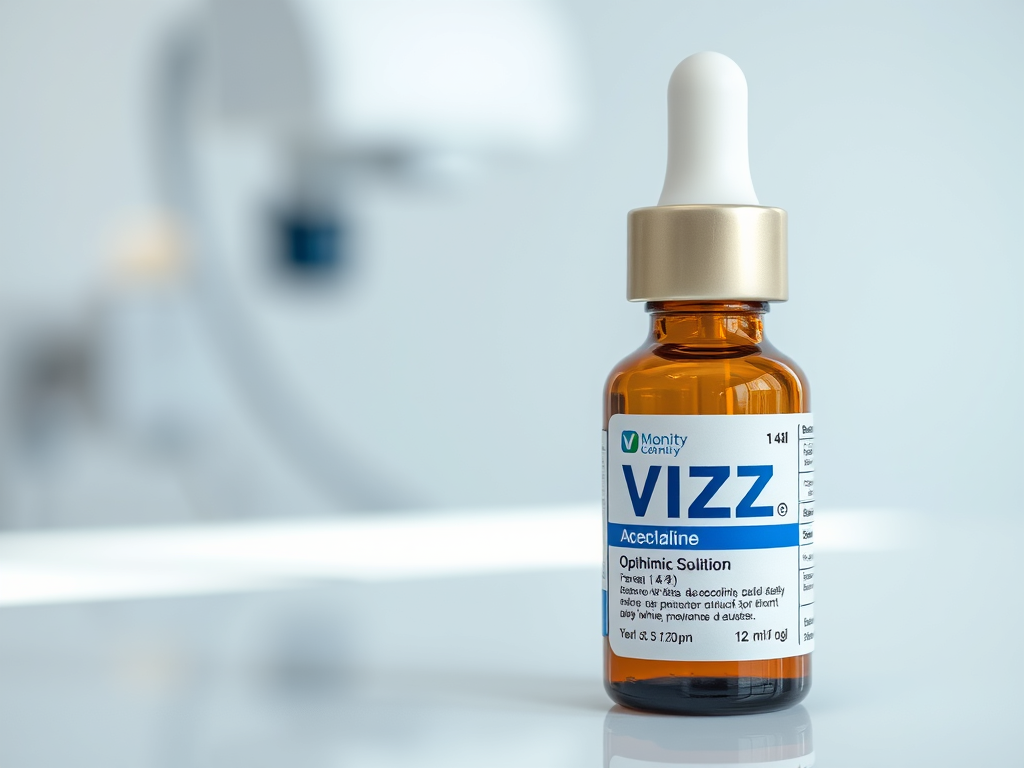
VIZZ (aceclidine ophthalmic solution 1.44%) received FDA approval on July 31, 2025, becoming the first aceclidine-based eye drop approved for presbyopia treatment. The approval was based on three Phase 3 CLARITY trials involving 1,059 participants, demonstrating statistically significant improvements in near vision with 65-71% of patients achieving ≥3-line improvement at 3 hours compared to 8-12% in control groups (p<0.01). However, systematic analysis reveals selective use of the most favorable results in marketing materials, absence of head-to-head comparisons with competitors despite comparative claims, and limited long-term safety data beyond 6 months.
The drug’s novel mechanism as a “pupil-selective miotic” with minimal ciliary muscle stimulation differentiates it from pilocarpine-based competitors like Vuity, though direct comparative trials were never conducted. With over 30,000 treatment days accumulated across trials, no serious treatment-related adverse events were reported, though common side effects included instillation site irritation (20%), dim vision (16%), and headache (13%). The regulatory landscape shows limited international progress, with only China having an active regulatory submission beyond the US approval.
Clinical evidence confirms primary efficacy but reveals selective reporting
The CLARITY trial program provides robust evidence for VIZZ’s efficacy in presbyopia treatment, though marketing materials consistently emphasize the most favorable results. CLARITY-1 demonstrated 65% efficacy (N=157) versus brimonidine control at 12%, while CLARITY-2 showed 71% efficacy (N=77) versus vehicle control at 8%. Marketing materials predominantly cite the 71% figure from the smaller CLARITY-2 study without always clarifying this represents the best-case scenario rather than the average across all trials.
The primary endpoint required participants to gain ≥3 lines in distance-corrected near visual acuity at 40cm without losing ≥1 line of distance vision at 4 meters, measured at 3 hours post-dose on Day 1. This combined endpoint was met with high statistical significance (p<0.01) in both pivotal trials. Secondary endpoints showed 95% of participants achieving ≥2-line improvement at 1 hour and 69% maintaining this at 10 hours, supporting duration claims.
Time-course analysis reveals 71% achieved improvement within 30 minutes in CLARITY-2, maintaining through 3 hours, with 40% still showing ≥3-line improvement at 10 hours. This supports the “up to 10 hours” duration claim, though the phrasing masks that only 40% of patients maintain clinically meaningful improvement at this timepoint. The number needed to treat (NNT) of 2 represents exceptional clinical effectiveness compared to Vuity’s reported NNT of 5 at 3 hours.
Safety profile shows no serious events but common mild reactions
Across more than 30,000 treatment days in the CLARITY program, zero serious treatment-related adverse eventswere reported, supporting the drug’s favorable safety profile. However, common adverse reactions occurred at notable rates: instillation site irritation affected 20% of patients, dim vision 16%, and headache 13% (vehicle-corrected rate 7.6%). All adverse events were characterized as mild, transient, and self-resolving, with 89% of headaches graded as mild severity.
The FDA-mandated warnings include cautions about blurred vision affecting driving ability, rare risk of retinal tear or detachment (class effect of miotics requiring baseline retinal examination), and caution in patients with history of iritis. The absence of serious systemic cholinergic effects differentiates VIZZ from pilocarpine, with mean systemic exposure (Cmax 2.114 ng/mL) remaining minimal.
CLARITY-3 provided 6-month safety data in 217 participants, representing the longest follow-up available. No long-term safety data beyond 6 months exists, creating an evidence gap for chronic use patterns. Post-marketing surveillance will be critical for identifying rare adverse events not captured in the clinical trial population of approximately 1,000 patients.
Regulatory review reveals limited international progress despite US success
The FDA approval process proceeded smoothly without advisory committee review, indicating no controversial issues requiring external expertise. The agency accepted the clinical significance of the 3-line improvement threshold and approved the broad indication for “treatment of presbyopia in adults” without imposing specific limitations beyond standard miotic warnings.
International regulatory status reveals a significant gap between US approval and global availability. Only China has an active NDA submission through partner CORXEL Pharmaceuticals, supported by a successful local Phase 3 trial showing 74% efficacy. Despite licensing agreements worth $290 million across Canada (Laboratoires Théa), Korea/Southeast Asia (Lotus Pharmaceutical), and China (CORXEL), no submissions to EMA, Health Canada, MHRA, TGA, or PMDA have been documented.
The absence of European development is particularly notable given aceclidine’s historical use in Europe for glaucoma treatment. Patent protection appears concentrated in the US with 97 patents filed, but minimal international patent coverage identified, potentially creating vulnerability in global markets.
Marketing claims show scope creep from studied population to broader claims
Critical analysis reveals systematic inflation of clinical findings in marketing materials. The claim that VIZZ could benefit “128 million adults with presbyopia” extends well beyond the studied population of ages 45-75 with specific refractive criteria (-4.0D to +1.0D spherical equivalent, astigmatism ≤2.0D). The trials included only 1,059 total participants, with efficacy data from 466 patients in the two pivotal studies.
Claims of superiority over Vuity lack direct evidence, as no head-to-head trials were conducted. Statements about avoiding “adverse outcomes seen in Vuity” rely on indirect comparisons and mechanistic arguments rather than comparative clinical data. The “pupil-selective” mechanism with 28:1 iris-to-ciliary muscle selectivity ratio versus pilocarpine’s 1.5:1 provides theoretical advantages, but clinical superiority remains unproven.
The promotion of 41% of participants showing distance vision improvement represents a secondary finding not powered as a primary endpoint, exemplifying discussion-section inflation where exploratory findings are presented as core benefits. Similarly, patient survey results showing 90% noticed improvement and 75% would continue use come from subjective assessments rather than objective visual acuity measurements.
Critical evidence gaps limit comprehensive assessment
Several crucial evidence gaps limit the ability to fully validate marketing claims against clinical reality. No quality of life measures or validated patient-reported outcome instruments were included in the CLARITY trials, making claims about “transformative” impact on daily life unsubstantiated. Cost-effectiveness analyses are entirely absent, preventing assessment of value propositions.
Real-world effectiveness studies do not exist, leaving questions about performance outside controlled trial conditions. The trials’ broad inclusion criteria (including post-LASIK and pseudophakic patients) provide some real-world applicability, but effectiveness in routine clinical practice remains unknown. Head-to-head comparison trials with Vuity or other presbyopia treatments were never conducted, making competitive positioning claims speculative.
Long-term safety beyond 6 months has not been studied, creating uncertainty about chronic use over years. Given presbyopia’s progressive nature and the target population’s expected decades of potential use, this represents a significant knowledge gap. The potential for tolerance development or efficacy reduction over time remains unexplored.
International regulatory landscape remains underdeveloped
Despite FDA approval and established international partnerships, the global regulatory strategy appears nascent. China’s NDA submission based on local Phase 3 data (74% efficacy at 3 hours) represents the only active international filing. The absence of EMA submission is particularly striking given Europe’s large presbyopia market and aceclidine’s historical use there for glaucoma.
Licensing partners have committed to “initiate registration processes” but no specific timelines exist. The reliance on US clinical data for international approvals may prove challenging given regulatory preferences for local studies. The lack of international patent filings beyond the US creates potential competitive vulnerabilities in global markets.
The “global first” positioning for aceclidine in presbyopia appears accurate, providing first-mover advantages. However, the slow international rollout may limit the ability to capitalize on this positioning before competitors develop similar or superior treatments.
 System D