

The Great Puzzle of Human Aging,
INGA314.com analysis
https://www.nature.com/articles/s41591-024-03483-9
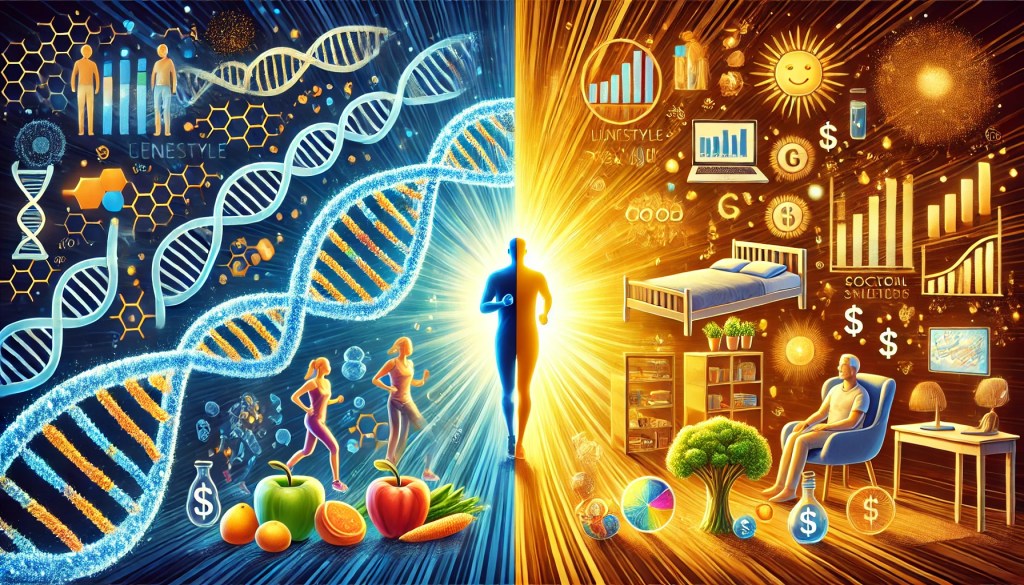
What determines how long we live? Is it written in our genes, or shaped by the lives we lead? A groundbreaking 2025 study published in Nature Medicine claims to have finally quantified the answer—and the results might surprise you.
Researchers from Oxford University and several international institutions analyzed data from nearly half a million participants in the UK Biobank to determine whether our genes or our environment plays the bigger role in how we age and when we die.
Their conclusion? Environment matters more than genetics when it comes to mortality and most age-related diseases.
But as with any ambitious research tackling life’s biggest questions, the story isn’t quite so simple. When examined through a logical analysis framework (LAF), fascinating contradictions and paradoxes emerge about human aging and the study’s conclusions.
Genes vs. Environment: The Numbers
The study found that while genetic factors (measured through polygenic risk scores) only explained about 2-3 percentage points of mortality variation beyond age and sex, environmental factors explained an additional 17 percentage points.
In practical terms, this suggests that modifiable factors in our daily lives—from smoking status to socioeconomic circumstances, physical activity to sleep patterns—collectively have a far greater impact on our lifespan than the genetic cards we’re dealt at birth.
The research identified several factors with particularly strong protective effects:
- Household income
- Being employed
- Asian, Black or other ethnicity (compared with white)
- Self-reported physical activity
- Living with a partner (compared with living alone or with other non-partners)
Conversely, some of the factors most strongly associated with increased mortality risk included:
- Current smoking
- Living in council housing versus home ownership
- Frequency of feeling tired
The study specifically quantified how much variation in disease risk could be explained by genetics versus environment:
- Predominantly influenced by genetics: The genome explained a greater proportion of variation (10.3–26.2%) compared with the exposome for incidence of dementias and breast, prostate and colorectal cancers.
- Predominantly influenced by environment: The exposome explained a greater proportion of variation (5.5–49.4%) compared with polygenic risk for incidence of diseases of the lung, heart and liver.
The Paradoxes That Make You Think
What makes this research particularly fascinating are the contradictions and puzzles it reveals:
The Ethnicity Paradox
One of the most striking findings was that Black, Asian, and “other” ethnicities had lower mortality risk compared to whites, even after adjusting for socioeconomic factors. This directly contradicts the fact that these same groups report living in higher deprivation areas, having poorer self-rated health, and worse experiences with health services.
What invisible protective factors might be at work here? Cultural practices? Social connections? Dietary patterns? The authors admit they don’t know, highlighting how much we still have to learn.
The Smoking-Prostate Cancer Paradox
In a finding that seems to defy common sense, current smoking was associated with a decreased risk of prostate cancer. This persisted even after controlling for prostate-specific antigen testing.
This doesn’t mean you should take up smoking to protect your prostate! Rather, it points to the complex ways our bodies respond to environmental exposures, and possibly to detection biases in how diseases are diagnosed.
The Brain Cancer Anomaly
While the researchers found associations between their identified exposures and nearly every disease they studied, brain cancer stood alone. Not a single exposure showed meaningful association with brain cancer risk.
This exception to the pattern raises profound questions about the unique development of brain cancers and suggests there may be fundamental differences in how various diseases interact with our environment.
What This Means For You
The study identified 25 key exposures that influence mortality and aging, 23 of which researchers classified as “potentially modifiable.” These include:
- Smoking status
- Socioeconomic factors (income, housing, employment)
- Physical activity levels
- Living arrangements (with a partner vs. alone)
- Sleep patterns
- Mental and physical wellness measures
- Early life factors (height/body size at age 10, maternal smoking)
While some of these factors (like socioeconomic status) may not be easily changed at the individual level, many are within our control. The research suggests that focusing on these environmental factors might offer more immediate benefits for extending healthy lifespan than genetic interventions.
The Bigger Picture
This research represents a significant step forward in understanding the complex interplay between our genes and environment in determining how we age and when we die. But it also reveals how much we still don’t understand.
The study could only explain about 50% of the variation in mortality and disease risk, even when combining age, sex, genetic, and environmental factors. This means there are still major unknown determinants influencing our health and longevity.
Perhaps most importantly, the research challenges us to think more holistically about aging. It’s not simply about genes OR environment, but rather a complex dance between the two, played out across our lifespan.
Critical Limitations: What the Study Gets Wrong
While this research makes important contributions, a logical analysis framework (LAF) reveals several significant limitations and inconsistencies that deserve scrutiny:
1. Definition vs. Implementation Problems
- Inconsistent Definition of “Exposome”: The study defines the exposome as “the total set of interrelated environmental exposures throughout the life course,” but operationalizes it using only 164 exposures measured at a single time point. This creates a fundamental mismatch between the comprehensive, longitudinal definition and its limited cross-sectional implementation.
- Limited Definition of “Genome”: The genetic component is approximated using polygenic risk scores (PRS) for just 22 diseases, a very narrow proxy for the entire genome’s contribution to aging and mortality. This methodological choice likely underestimates genetic contributions, potentially inflating the relative importance attributed to the exposome.
- Overstated “Independence” of Exposures: The paper claims to identify “25 independent exposures,” despite acknowledging that “90% of variable pairs showed evidence of significant correlation.” While statistical methods were used to address multicollinearity, true real-world independence is unlikely, making this claim somewhat misleading.
2. Filtering Bias and Circular Logic
- Proteomic Clock Filter: Of 85 exposures associated with mortality, 57 were discarded because they weren’t associated with a specific proteomic aging clock. This filtering assumes this particular clock captures all relevant aging biology—a questionable assumption that might prematurely discard important environmental factors.
- Contradictory Conclusions: The abstract concludes the “exposome shapes distinct patterns of disease and mortality risk, irrespective of polygenic disease risk.” Yet the results clearly show that for several major diseases (dementias, breast, prostate, and colorectal cancers), polygenic risk explains significantly more variation (10.3–26.2%) than the exposome.
3. Sample and Design Limitations
- Sample Bias: The UK Biobank population is healthier and more affluent than the general UK population. While the authors frame this as a “strength” for studying premature mortality, it introduces significant selection bias that limits generalizability.
- Single Time-Point Measurement: All exposures were measured at just one moment in participants’ lives, yet the study draws conclusions about lifelong exposure effects.
- Missing Gene-Environment Interactions: The researchers did not test for interactions between genes and environment, despite acknowledging they “undeniably have a joint influence.” This is a major blind spot in understanding how genetics and environment may amplify or mitigate each other’s effects.
4. Validation and Causality Issues
- No External Validation: The researchers attempted to validate their findings in the Rotterdam Study but couldn’t due to differences in exposure measurements, raising serious questions about generalizability.
- Causality Limitations: Despite their careful analytical pipeline, the authors acknowledge that “reported associations may not be causal.” This fundamental limitation means we should be cautious about translating these findings into interventions without further experimental evidence.
Putting the Research into Practice
If environment matters more than genetics for most aging outcomes, what practical steps might we take based on these findings?
Individual-Level Approaches
The modifiable factors identified in this study suggest several evidence-based strategies that may promote longevity:
- Smoking cessation: Unsurprisingly, smoking emerged as one of the strongest mortality predictors. The benefits of quitting occur at any age.
- Physical activity: Regular movement showed strong protective effects across multiple diseases and was significantly associated with reduced mortality.
- Sleep optimization: Both too little (<7 hours) and too much (>9 hours) sleep were associated with worse outcomes, suggesting the importance of finding your optimal sleep duration.
- Social connections: Living with a partner showed notable protective effects, highlighting the importance of meaningful social relationships for longevity.
- Stress and mental wellness: Frequent tiredness and lack of enthusiasm were associated with increased mortality risk, suggesting the importance of mental health for physical longevity.
Societal Implications
The research also highlights factors that require collective action:
- Socioeconomic disparities: Some of the strongest mortality predictors were socioeconomic factors like income, employment, and housing. This suggests that policies addressing economic inequality might be powerful public health interventions.
- Early life interventions: The associations between childhood factors (maternal smoking, relative height/body size at age 10) and adult mortality hint at the importance of early life environments in shaping lifelong health trajectories.
- Healthcare focus: The different patterns for different diseases suggest we might need disease-specific approaches to prevention, with some disorders benefiting more from environmental interventions and others from genetic screening.
The Philosophical Questions
This research raises profound questions about human agency and determinism:
- If our environment shapes our health outcomes more than our genes, does this mean we have more control over our destiny than we thought?
- Or does the strong influence of socioeconomic factors suggest our health is largely determined by social structures beyond individual control?
- How should we balance personal responsibility for health behaviors with societal responsibility for creating environments that enable healthy choices?
- If different diseases have different environmental vs. genetic patterns, should this change how we approach disease prevention and treatment?
What’s Next in Aging Research?
The authors acknowledge many limitations in their work. Future research will need to:
- Capture exposures across the entire life course, not just at a single time point
- Measure exposure-outcome relationships that may be non-linear
- Explore gene-environment interactions
- Develop standardized exposure measurements that can be compared across studies
As research technology improves, particularly in measuring environmental exposures through biomarkers, we may gain even deeper insights into how our daily choices and circumstances shape our aging trajectory.
For now, this study offers compelling evidence that while we can’t change our genes, there’s substantial room to influence how we age through the lives we lead.
What do you think? Does this research change how you view your own aging process? Would you prioritize different health behaviors based on these findings? Share your thoughts in the comments below!
This blog post offers a critical analysis of: Argentieri, M.A., et al. (2025). Integrating the environmental and genetic architectures of aging and mortality. Nature Medicine, 31, 1016-1025.
 System D